
There are now two Bloom’s Taxonomy, the original and the revised. If one looks closely, the revision is not a mere revision, but really a different taxonomy with a different structural basis. It is also worthy and useful. They have two different purposes and uses. Many people do not realize that the revised taxonomy is actually a 100% different model.
Back in the 1950’s a relatively large number of testers and assessors at a variety of notable institutions got together and wanted to prepare guidelines for how to assess existing course objectives: i) it was not about what should be taught or how things should be taught; and ii) the outcomes assessed related to what is done within an academic setting and not in everyday situations or upon graduation. These are the first two things to know about the original taxonomy.
Over a number of years, they met, discussed, and ultimately ended up with a report and since Bloom was the main editor, the work became known as Bloom’s Taxonomy. A key, a very key, aspect of the taxonomy was the hierarchy used. In the original, it was based on cognitive complexity, not the cognitive process. Keep this thought, it is the third thing to know and remember!
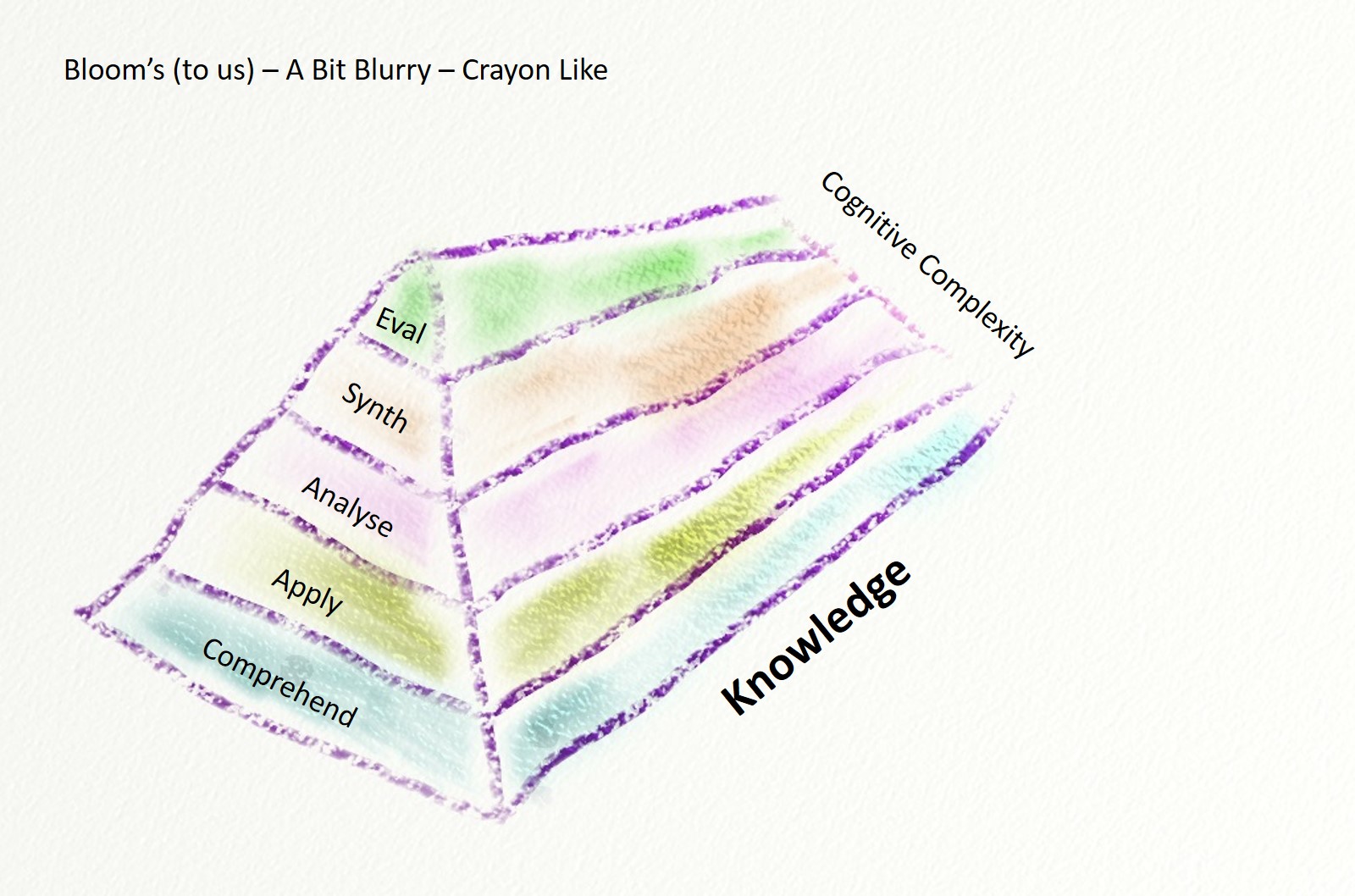
Although the original authors did not illustrate the taxonomy with a pyramid, it was a hierarchical, 3D model. They thought of knowledge as a bridging dimension: "the knowledge category differs from the others in that remembering is the major psychological process involved here, while in the other categories the remembering is only one part of a much more complex process of relating, judging, and reorganizing." They separated knowledge from the other layers, the other layers were called intellectual abilities and skills; knowledge was different. If you were to draw what they described, it would be a three dimensional model, not a pyramid or triangle. This is the fourth bit of knowledge about the original Bloom’s taxonomy that is important to understand (It was not a triangle!).
They broke down most of the dimensions into two discrete categories, knowledge and intellectual abilities and skills. The knowledge category was:
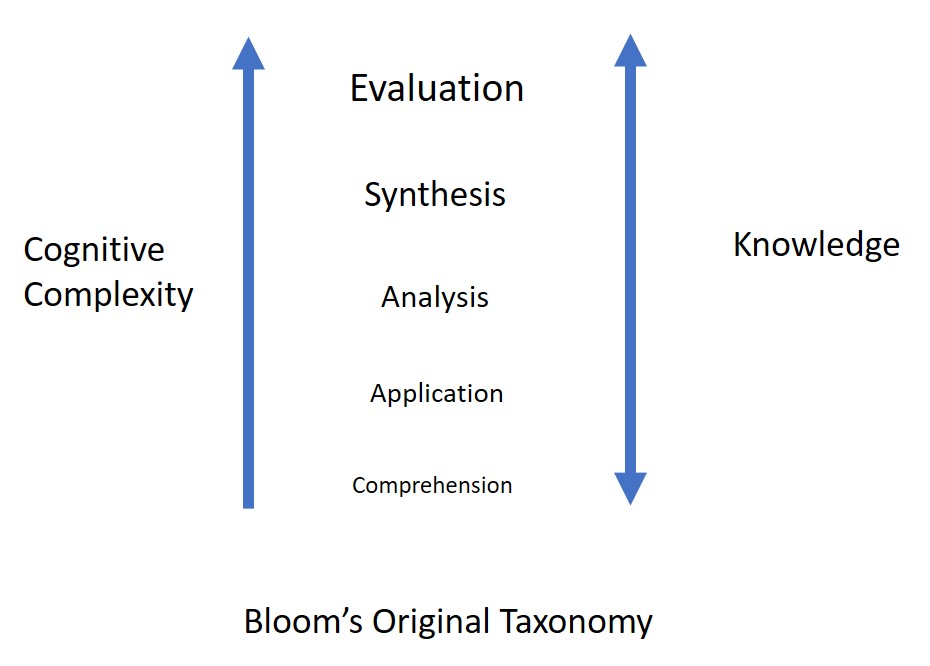
Everything else was considered an intellectual ability and skill; the comprehension, apply, analyse, synthesis, evaluate layers. In each of these topics, there is knowledge to acquire about the specifics, the ways, the universals, and abstractions.
Evaluation was considered the highest level of cognitive complexity because the evaluator's knowledge has to be deeper and broader than that encapsulated in the 'item' someone just synthesised or pulled together (or other options to choose from that might be on the table). To evaluate, you need to know what was done and what could have been done! The evaulator has to know more and be better than the synthesizer.
Although the taxonomy was created in the 1950’s based on what was known then, the complexity hierarchy still stands up when viewed with modern cognitive science and what we know about how people solve problems. We do not think that there is anything ‘wrong’ with the original taxonomy for the purposes of thinking about the complexity of thought; remembering, thinking, problem-solving, creating, and evaluating. It was three-dimensional and the order is supported by science.
The original report should be read and can be found online and probably in your library. It is full of insight that still rings true today. For example, read each sentence in the following from page 34 and reflect, comprehend its significance and relevance to today:
Quite frequently we tend to think of knowledge as something which is learned as the result of simply presenting it to the learner in one form of communication or another. Clearly related to this is the ease with which it is possible to gauge the extent to which the student has acquired knowledge. Practically all teachers have considerable confidence in their ability to build tests of knowledge. Because of the simplicity of teaching and evaluating knowledge, it is frequently emphasized as an educational objective out of all proportion to its usefulness or its relevance for the development of the individual. In effect, the teacher and school tend to look where the light is brightest and where it is least difficult to develop the individual.
If you enjoyed the above excerpt, you would probably enjoy the whole section in the original report. It is full of subtle criticism and sarcasm regarding education and is aligned with Zimmerman’s (2020) modern critique – The Amateur Hour.
Reading Bloom's original, you will find what we now consider to be modern and cutting-edge ideas such as threshold concepts and learning-to-learn – page 36:
Decisions with respect to "How much knowledge should be required learning?" must strike a balance between attempts to include all the knowledge the individual might conceivably acquire in a particular subject and only that knowledge which is most basic to the subject. Rarely does the educator lean toward the latter of these two alternatives. Some educators frequently assume that the knowledge which the expert or specialist needs to possess about a field or topic and the knowledge which the beginning student may reasonably be expected to learn are identical. Such an assumption tends to overestimate the student's ability to learn and retain information. These educators must decide whether the student's time and effort are best used in becoming acquainted with the major knowledge in the field or in thoroughly mastering that knowledge which is basic to further learning in the field.
There is now something called a revised Bloom’s Taxonomy (Anderson and Krathwohl 2001). We would have preferred them to use a different name for this ‘new’ model. A revision implies that the former is out of date and is not relevant. The ‘new’ taxonomy is not really a revision. They can call it that, but it is not. It is a model that is based on what is considered by the revisionists to be the cognitive process. Process and complexity are not the same things. Far from it. They are two different models. We hate it when people mix up apples with oranges. An orange is not a revised apple.
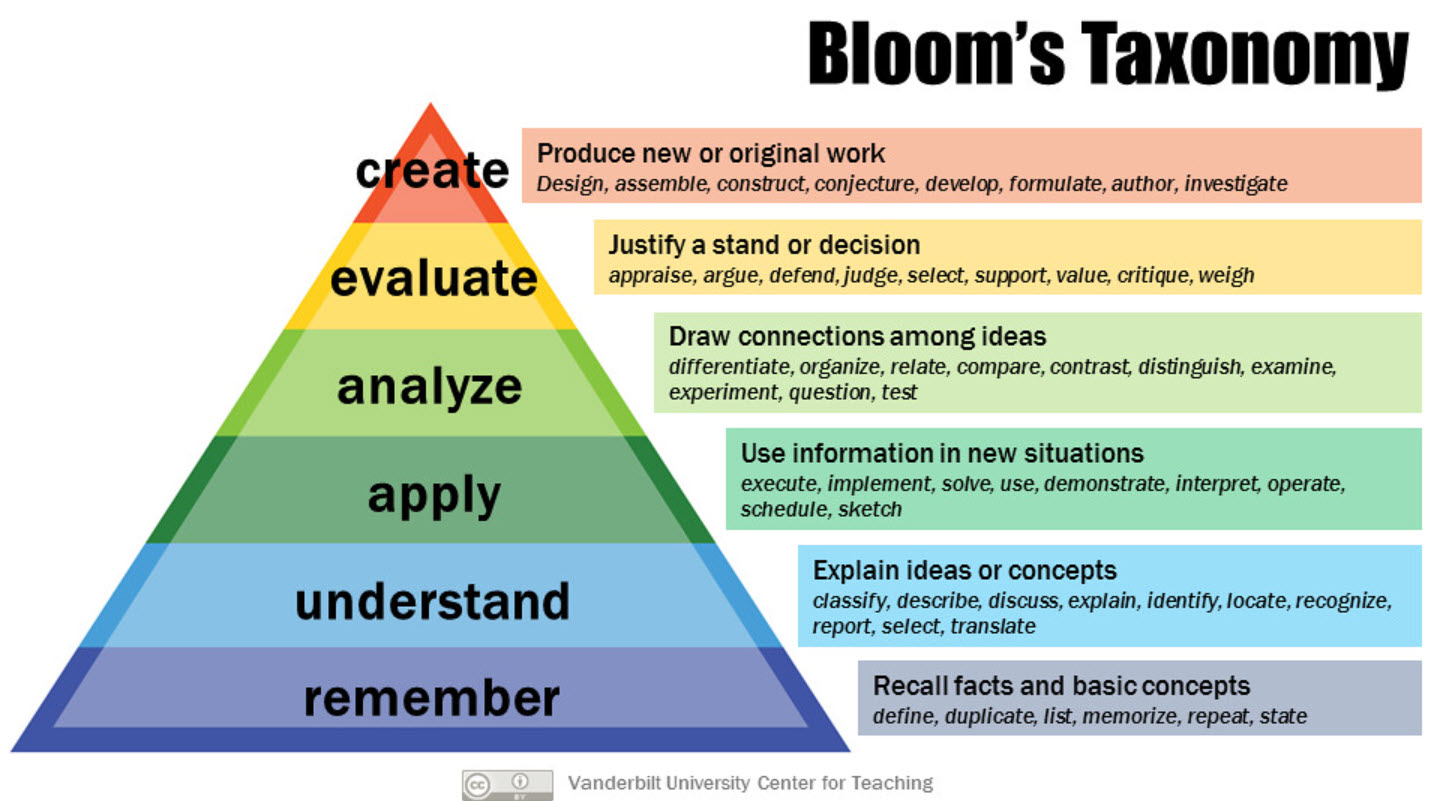
However, this ‘new’ taxonomy is useful as well. It is suggested that instructors know both and use both! From a cognitive science perspective, the ‘new’ taxonomy represents one form of problem-solving and thinking that is rational and systematic; this is a very important one for many situations and maps well onto the academic situation as a student goes from first year to graduation. It is good for text-book like questions and problems. It is not how experts solve problems, and it is not how disruptive thinking and the extreme levels of creativity happen, but it is a reasonable starting point. Users of the ‘new’ model should understand its limitations and still use and think about the original Bloom’s Taxonomy.
Throughout the website, we use the original Bloom’s Taxonomy for thinking about cognitive complexity, and use ideas from the 'new model' to discuss the cognitive process.
Perhaps some of the confusion arises because if the complexity taxonomy is incorrectly drawn as a pyramid, it will resemble the structured learning process of recipes and well-structured problem-solving. This can lead people to forget the original structure and assume that the original Bloom’s Taxonomy was a process model which it was not.
As a process model of thinking and problem-solving, the ‘new’ model can be also considered incomplete, but adequate for certain teaching purposes. If the teaching is not experiential in the context of actually making something, going beyond words or a design, it is fine. Students are given a problem, they have to create a solution, do some evaluation during the process of creating and then it is handed in. Done. Game over. They do not get a chance to actually use their creation, nor evaluate it.
In a real problem-solving situation, there should be the evaluation during analysis, creation, and evaluation of the creation in the situation. This implies that the ‘new’ model should have another layer for experiential or project-based learning. There should be another layer of evaluation above “create”. Evaluating options and issues during the creation phase is not the same cognitive task as evaluating the final creation. There are different criteria, knowledge, and tools in play.
Before leaving the ‘revision’, we also note that the four major types and subtypes (factual, conceptual, procedural, and metacognitive) can also be found in the original knowledge category. If one does not want to read the full taxonomy derivation in the original, we suggest the appendix where it is summarized – pages 201-207.
The creators of the original taxonomy limited their scope to assessing learning, and it is important to marry the assessment theory to learning theory and this is what they suggested. When students enter higher education, they are naïve and novice thinkers and appropriate expectations for intellectual abilities must be set accordingly. We know from Cognitive Science that junior thinkers think differently from expert thinkers and this should guide both the learning and assessment methods. In fact, if one uses a Cognitive Science lens, it is not clear how high up the cognitive skill and expertise level a typical student can climb during the post-secondary part of their education. Without a great deal of explicit and deliberate practice, it is likely that students will exit post-secondary with more knowledge, facts, and recipes but ‘thinking’ exactly the same as they entered; there will be no noticeable difference in the ability to comprehend, apply, analyze, synthesize, or evaluate.

Until the learners develop non-superficial skill, there are a number of ideas for how to assess junior thinking; at the various levels in the taxonomy. We suggest the following for the novice and naïve learners:
At more senior levels, ill-structured problems can be assigned with various levels of ‘instruction’ and ‘clarity’ depending on the learners’ skill. This style of teaching, assessment must be backed up by what is said in class and during class discussions:
If you are going to teach and assess the higher levels, the key elements are:
